Classic Italian Panettone: The First Dough
Recipe by user david
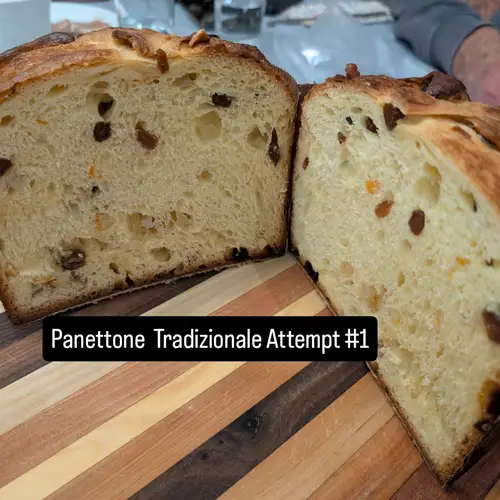
A traditional two-dough Italian panettone with honey-citrus-vanilla flavouring and mixed dried/candied fruit, baked until tall and airy.
This classic Italian panettone is made with a pre-made honey, citrus zest, and vanilla flavouring that rests 24 hours for a deep, aromatic profile, then built through two mixing phases for strength and an ultra-stringy, glossy dough. It’s ideal for Christmas and holiday tables, gifting, or any celebratory brunch, served simply sliced or lightly toasted. Key tips: use a strong, active lievito madre at the right maturity, keep fermentation warm (26–28°C) without letting the dough touch the cover, and add water gradually in the second dough to maintain a stretchy, “stringy” structure. Cool the baked panettoni inverted after skewering to prevent collapse, then package only after resting 12 hours post-bake.
Flavour
- 40 g 40 g honey
- 1 1 medium orange, zested
- 1 1 lemon, zested
- 1 1 vanilla bean
- 40 g 40 g honey
- 1 1 medium orange, zested
- 1 1 lemon, zested
- 1 1 vanilla bean
To give the panettone its characteristic flavour, it is advisable to prepare the following mixture 24 hours before mixing it into the dough.
Grate the zest of the citrus fruit and add it to the honey together with the seeds from the vanilla pods. Stir the mixture together and let it rest in the refrigerator for 24 hours.
Grate the zest of the citrus fruit and add it to the honey together with the seeds from the vanilla pods. Stir the mixture together and let it rest in the refrigerator for 24 hours.
First dough
We suggest making the first panettone dough in the evening.
We suggest making the first panettone dough in the evening.
- 100 g 100 g sugar
- 250 g 250 g water
- 500 g 500 g type “00” panettone flour
- 100 g 100 g sugar
- 250 g 250 g water
- 500 g 500 g type “00” panettone flour
First, whip the sugar and the water together and then add the flour.
- 120 g 120 g lievito madre, about three hours after the third refreshment
- 100 g 100 g large egg yolks
- 120 g 120 g lievito madre, about three hours after the third refreshment
- 100 g 100 g large egg yolks
Mix in the sourdough, which must be strong, then add the egg yolks a little at a time, taking care that the dough does not split.
- 150 g 150 g unsalted butter
- 150 g 150 g unsalted butter
Finally, add the butter, softening it slightly if necessary (Figure 1).
This phase takes from 20 to 25 minutes when using a spiral mixer and a few minutes more with a plunger mixer.
This phase takes from 20 to 25 minutes when using a spiral mixer and a few minutes more with a plunger mixer.
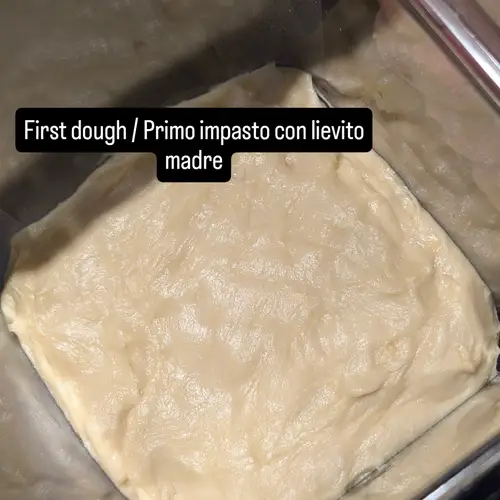
After the first mixing phase, place the dough in a container, cover it with a nylon cloth and leave it to rise at a temperature of 26-28 °C. Over the course of twelve hours, the dough will increase to one and a half times its initial volume. N.B. The top of the dough must never touch the cloth covering it. The top of the dough must reach approximately level 3 as shown in the image below (Figure 2).
After the first mixing phase, place the dough in a container, cover it with a nylon cloth and leave it to rise at a temperature of 26-28 °C. Over the course of twelve hours, the dough will increase to one and a half times its initial volume. N.B. The top of the dough must never touch the cloth covering it. The top of the dough must reach approximately level 3 as shown in the image below (Figure 2).
Second dough
Since the first dough, started in the evening, takes about twelve hours to rise, the second panettone dough should be made the following morning.
Since the first dough, started in the evening, takes about twelve hours to rise, the second panettone dough should be made the following morning.
- 120 g 120 g type “00” panettone flour
- 8 g 8 g salt
- 120 g 120 g type “00” panettone flour
- 8 g 8 g salt
First the structure and strength needs to be restored to the first dough by putting it in the mixer and adding all the flour and the salt for the second dough. After this initial phase, the mass should look like the photo below (Figure 3).
- 120 g 120 g large egg yolks
- 150 g 150 g sugar
- 120 g 120 g large egg yolks
- 150 g 150 g sugar
Gradually add the egg yolks and the sugar alternately, making sure that the dough remains stringy.
- 40 g 40 g panettone flavouring, from above
- 200 g 200 g unsalted butter
- 40 g 40 g panettone flavouring, from above
- 200 g 200 g unsalted butter
Add the flavouring prepared the previous day (see how later in the recipe), and the butter, slightly softened if necessary (Figure 4).
- 100 g 100 g water, approx. (to be measured by evaluating the absorption and consistency of the dough)
- 100 g 100 g water, approx. (to be measured by evaluating the absorption and consistency of the dough)
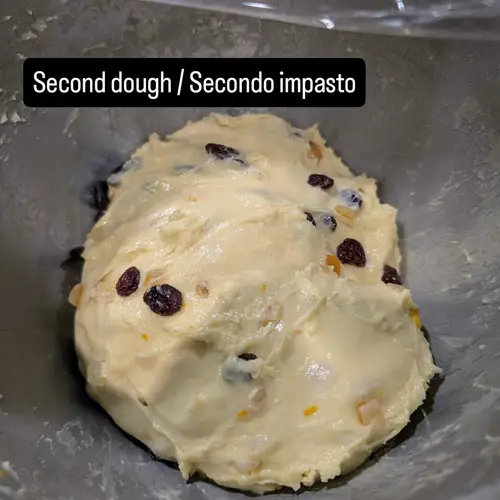
Now add the water until the dough reaches the proper consistency, taking care that the panettone dough remains stringy. We suggest adding 200g of water at a time, adding it all if necessary, but without exceeding 1kg. To understand if the dough is properly hydrated, evaluate its stringiness, gloss and stretchability. The images below give an idea of the appearance and consistency that the dough should have at the end of this second phase (Figure 5).
- 180 g 180 g raisins, soaked the previous day
- 180 g 180 g candied orange peel
- 90 g 90 g candied citron peel
- 180 g 180 g raisins, soaked the previous day
- 180 g 180 g candied orange peel
- 90 g 90 g candied citron peel
Finally add the dried fruit, namely the raisins, the candied orange and candied citron peel.
The second phase of mixing the panettone lasts about 35-40 minutes.
The second phase of mixing the panettone lasts about 35-40 minutes.
Leave the dough to rise for about one and a half hours in a container covered with a nylon cloth, at a temperature of 26-28 °C.
Leave the dough to rise for about one and a half hours in a container covered with a nylon cloth, at a temperature of 26-28 °C.
Shaping and Baking
To obtain 1kg panettones, divide the dough into 1.1kg pieces (10% more than the weight of the panettone after cooking)
To obtain 1kg panettones, divide the dough into 1.1kg pieces (10% more than the weight of the panettone after cooking)
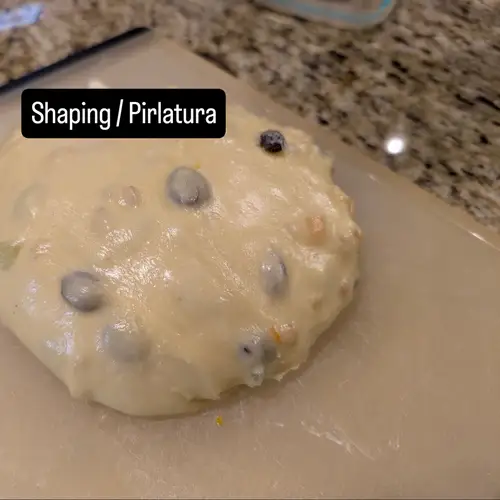
Roll each piece into a compact ball and leave to rise and form a skin for about twenty minutes on the work surface.
Roll each piece into a compact ball and leave to rise and form a skin for about twenty minutes on the work surface.
Taking care not to tear the surface of the dough, roll the balls around again before placing them into the paper moulds.
Taking care not to tear the surface of the dough, roll the balls around again before placing them into the paper moulds.
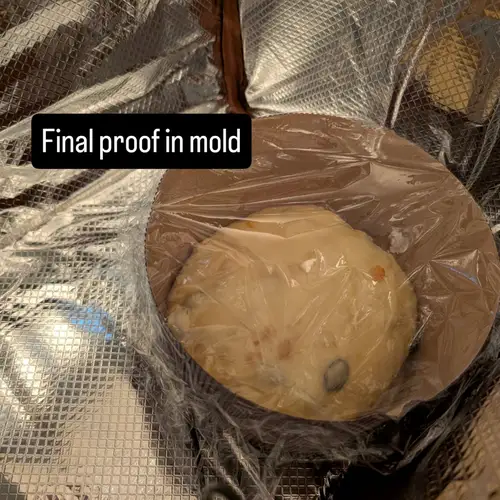
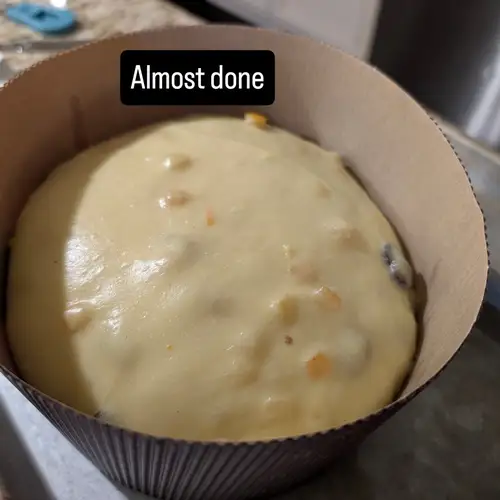
Leave each panettone to rise until it is one centimetre from the top of the mould if you are using low-sided moulds, or 2 cm from the top if you are using high-sided moulds, for about 5/6 hours at a temperature of 26-28 °C.
Leave each panettone to rise until it is one centimetre from the top of the mould if you are using low-sided moulds, or 2 cm from the top if you are using high-sided moulds, for about 5/6 hours at a temperature of 26-28 °C.
- butter, knob, to add to the centre of the cut
- butter, knob, to add to the centre of the cut
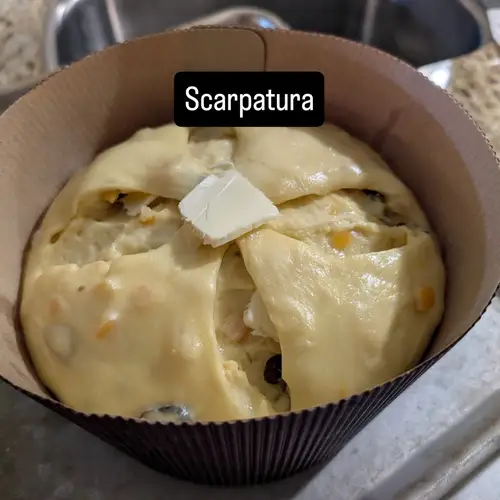
Once risen cut a cross into the top of the panettone, and add a knob of butter to the centre of the cut, as shown in the image below (Figure 6).
Bake the panettones at 165 °C for 50 minutes or until the centre reaches 94 °C. In the case of smaller panettones, slightly increase the temperature and reduce the cooking time.
Bake the panettones at 165 °C for 50 minutes or until the centre reaches 94 °C. In the case of smaller panettones, slightly increase the temperature and reduce the cooking time.
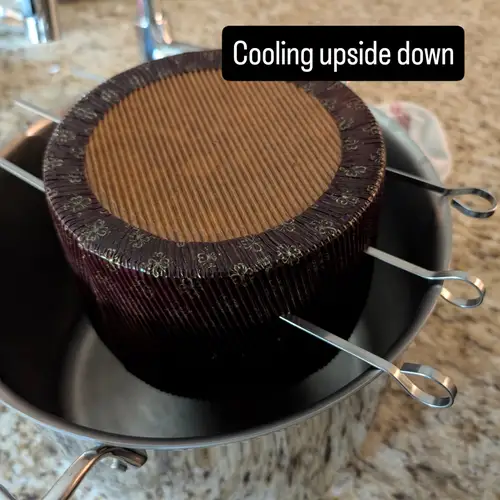
Once out of the oven, skewer the panettones in the lower part of the mould and turn them over to cool.
Once out of the oven, skewer the panettones in the lower part of the mould and turn them over to cool.
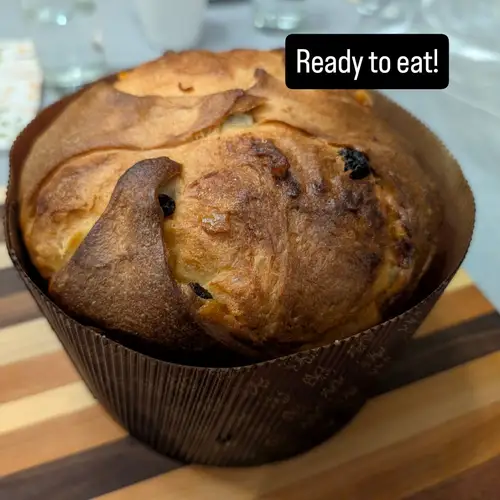
Pack 12 hours after the end of cooking.
Pack 12 hours after the end of cooking.
Notes
We suggest making the first panettone dough in the evening.
This phase takes from 20 to 25 minutes when using a spiral mixer and a few minutes more with a plunger mixer.
N.B. The top of the dough must never touch the cloth covering it. The top of the dough must reach approximately level 3 as shown in the image below (Figure 2).
We suggest adding 200g of water at a time, adding it all if necessary, but without exceeding 1kg.
To obtain 1kg panettones, divide the dough into 1.1kg pieces (10% more than the weight of the panettone after cooking)
In the case of smaller panettones, slightly increase the temperature and reduce the cooking time.
Pack 12 hours after the end of cooking.
Nutrition Information
| Nutrient | Total |
|---|---|
| Calories | 0 |
| Protein | 0.0g |
| Fat | 0.0g |
| Saturated Fat | 0.0g |
| Carbohydrates | 0.0g |
| Fiber | 0.0g |
| Sugar | 0.0g |
| Sodium | 3096mg |
| Cholesterol | 0mg |
Values shown are totals for the entire recipe. Add serving information to see per-serving nutrition.
Thanks for visiting my site. | master-5c20438 (docker)