Gyudon (Japanese Beef Rice Bowl)
Recipe by user david
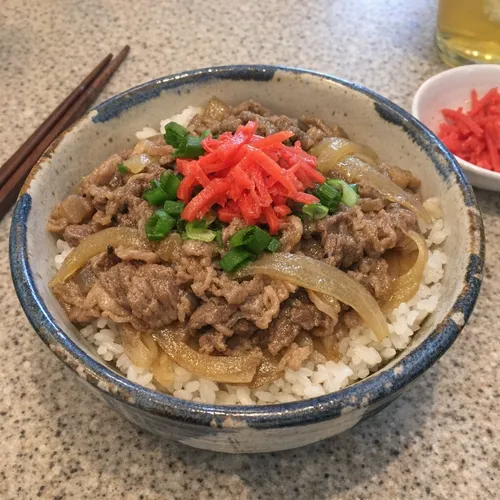
Thinly sliced beef and onions simmer in a savory-sweet dashi sauce and are served over steamed short-grain rice.
Serves 2
Gyudon is a classic Japanese donburi comfort food: tender onions and thinly sliced beef quickly simmered in a savory-sweet dashi-based sauce, then spooned over hot Japanese short-grain rice. It’s ideal for an easy weeknight dinner because it comes together fast (about 20 minutes) and uses simple pantry staples like soy sauce, sugar, and mirin. For best results, slice the onion thinly so it softens quickly, keep the pan at a gentle simmer to avoid toughening the beef, and skim any scum/fat for a cleaner-tasting broth. Serve immediately in donburi bowls with pickled red ginger on top; beaten egg can be added at the end if desired.
- 1⁄2 cup (120 g) water
- 0.12 piece kombu (dried kelp) (1/3 oz, 10 g per piece; 4 x 4 inches or 10 x 10 cm)
Add water and kombu (dried kelp) to a medium saucepan. If you have time, soak the kombu in water for 30 minutes. NEVER wash kombu and do not remove the white substance—that’s umami! These days, it‘s pretty clean, so just make sure there are no dirt particles.
SLOWLY bring it to a boil (about 10 minutes) on medium-low heat so you can extract as much umami from the kombu as possible. Right before the stock boils, remove the kombu and set it aside for another use. (If you leave the kombu, it gets slimy and yields a bitter taste.) Now, what you have is Kombu Dashi. If you’re vegetarian/vegan, use this kombu dashi for your miso soup.
- 1 Tbsp, 2 3⁄4 tsp katsuobushi (dried bonito flakes), packed
If you‘re not vegetarian/vegan, add katsuobushi (dried bonito flakes) to the kombu dashi and bring it back to a boil again. Once the dashi is boiling, reduce the heat, simmer for just 30 seconds.
Turn off the heat and let the katsuobushi sink to the bottom, about 10 minutes. Then, strain through a fine-mesh sieve.
Now you have roughly 4 cups of Awase Dashi. You can store the dashi in the refrigerator for up to 3–5 days and in the freezer for up to 2 weeks. Reserve the spent katsuobushi and repurpose it; see the suggested recipes that follow at the end of the instructions.
- 2 rice cooker cups japanese short-grain rice
Measure the uncooked rice into a large bowl.
- 400 mL (400 g) water
Quick-rinse the rice: add enough water to cover, drain immediately, and repeat once. Wash by gently rubbing the wet rice in a circular motion for 10–15 seconds with minimal water. Rinse by adding water and draining immediately; repeat once. Repeat the wash and rinse cycle two more times, then drain well when the water is almost clear.
Transfer the drained rice to the rice-cooker pot, add the measured water (not warm or hot), and level the rice so it’s evenly submerged.
Soak for 20–30 minutes, then select the menu and press Start to cook.
If your cooker doesn’t include steaming, let the rice sit for 10 minutes. Open the lid and fluff with a rice paddle.
To store: transfer cooked rice to airtight containers, close the lid to retain moisture, cool completely, and freeze.
- 0.5 0.5 onion
- 0.5 0.5 onion
Thinly slice the onion.
- 1 stem 1 stem green onion
- 1 stem 1 stem green onion
Cut the green onion/scallion diagonally into thin slices; set aside.
- 8 oz 8 oz (230 g) beef ribeye, thinly sliced
- 8 oz 8 oz (230 g) beef ribeye, thinly sliced
If semi-frozen, cut the thinly sliced beef into pieces about 3 inches (7.6 cm) wide.
- 1⁄2 cup 1⁄2 cup (120 g) dashi (japanese soup stock)
- 2 Tbsp 2 Tbsp (30 g) sake or dry sherry or Chinese rice wine or water
- 2 Tbsp 2 Tbsp (32 g) mirin or sake or sugar
- 3 Tbsp 3 Tbsp (48 g) soy sauce
- 1 Tbsp 1 Tbsp (12 g) sugar, to taste
- 1⁄2 cup 1⁄2 cup (120 g) dashi (japanese soup stock)
- 2 Tbsp 2 Tbsp (30 g) sake or dry sherry or Chinese rice wine or water
- 2 Tbsp 2 Tbsp (32 g) mirin or sake or sugar
- 3 Tbsp 3 Tbsp (48 g) soy sauce
- 1 Tbsp 1 Tbsp (12 g) sugar, to taste
In a large frying pan (heat off), combine the dashi, sake, mirin, soy sauce, and sugar; stir to dissolve the sugar.
Add the onion slices, spread them through the broth, and separate the layers.
Add the onion slices, spread them through the broth, and separate the layers.
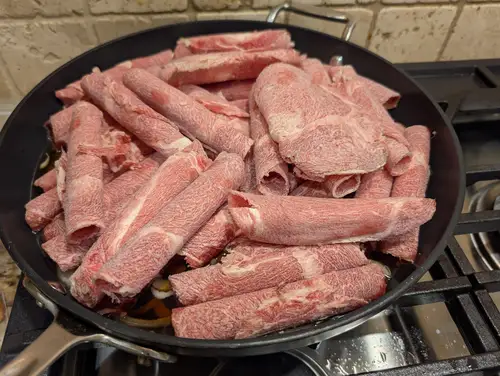
Layer the beef over the onions, separating the slices so they cover the onions.
Layer the beef over the onions, separating the slices so they cover the onions.
Cover, turn heat to medium, and bring to a simmer; reduce to a gentle simmer and cook covered for 3–4 minutes.
Cover, turn heat to medium, and bring to a simmer; reduce to a gentle simmer and cook covered for 3–4 minutes.
Open the lid once or twice and skim scum and fat from the broth.
Open the lid once or twice and skim scum and fat from the broth.
- 1 1 (51 g) large egg (optional), beaten
- 1 1 (51 g) large egg (optional), beaten
Sprinkle the green onions on top; cover and cook 1 minute. If using beaten egg, add it now.
- 4 1⁄3 cups 4 1⁄3 cups (885 g) Japanese cooked white rice
- 4 1⁄3 cups 4 1⁄3 cups (885 g) Japanese cooked white rice
Divide the cooked Japanese short-grain rice into donburi bowls; drizzle some pan sauce over the rice.
- pickled red ginger (beni shoga or kizami beni shoga)
- pickled red ginger (beni shoga or kizami beni shoga)
Top the rice with the beef and onion mixture; drizzle more sauce if desired and garnish with pickled red ginger.
Nutrition Information
| Nutrient | Per Serving | Total |
|---|---|---|
| Calories | 295 | 590 |
| Protein | 21.2g | 42.4g |
| Fat | 22.7g | 45.4g |
| Saturated Fat | 9.0g | 18.1g |
| Carbohydrates | 0.0g | 0.0g |
| Fiber | 0.0g | 0.0g |
| Sugar | 0.0g | 0.0g |
| Sodium | 48mg | 96mg |
| Cholesterol | 71mg | 142mg |
Per serving values based on 2 servings.
Thanks for visiting my site. | master-2c51d72 (docker)